In an application to appeal a decision, the applicant writes each question of lawas a single question. For example, was VCAT correct to decide that a retirement village tenancy agreement can only be terminated under section 16 of the Retirement Villages Act 1986? Quo warrantoA type of judicial review where the court requires a person to demonstrate the legal basis for their exercise of an office or official function.

Some types of documents must be served in person, while others can also be served by email, post or fax.SolicitorA commonly used name for a lawyer. This term also refers to when the court rules that parts of a claim or defence cannot relied on and 'strikes out' these parts. Unless the charges against you are dismissed or you enter a plea of guilty or nolo contendere, your case will go to trial.

In a jury trial, the judge presides over the courtroom proceedings, and six or more citizens from the community are chosen to hear the evidence presented against you. These citizens determine whether a crime has been committed and whether you are criminally responsible for that crime. In a non-jury trial, the judge alone decides whether a crime has been committed, and whether you are criminally responsible for that crime. After your first appearance, if formal charges are filed, an arraignment will be scheduled. The arraignment is not a trial and not a time when evidence or witnesses can be presented. At most arraignments you are informed of the charges against you, and if you do not have a lawyer the Public Defender's Office may be appointed to represent you, if you qualify.

You may either appear in person for arraignment, or, in appropriate cases, you attorney may file a written plea of not guilty on your behalf. You must attend your arraignment in person unless your attorney has specifically told you otherwise. If a plea of not guilty is entered at your arraignment, your case will normally be scheduled for a pretrial conference. In Category 2 cases where a trial sees a judge hearing the case without a jury, the review hearing takes place 30 working days after a defendant pleads not guilty to an alleged crime. For Category 3 or higher offences, the defendant may choose to have a jury trial.

In these cases, the case review hearing takes place 45 working days after a plea of not guilty is entered. To get a case review hearing, the defense and the prosecution must jointly file a Case Management Memorandum, which tells the court what the issues are to be at trial and other details of the case. The Memorandum has to be filed at least 5 working days before the case review date, according to Community Law Manual. Civil cases include every type of legal action except criminal actions, including personal injuries, contract disputes, adoptions, divorces and faulty consumer goods.
The party bringing suit, or plaintiff, must prove his or her case before a judge or jury by presenting evidence that is more persuasive than the opposing evidence . Some aspects of civil cases—divorce, support or child custody matters—may be heard before quasi-judicial officers, including hearing masters or conference officers. Findings of fact and other "essentially factual" issues are reviewed forclear error.SeeHusain v. Olympic Airways, 316 F.3d 829, 835 (9th Cir. 2002).

This standard is derived from the Federal Rules of Civil Procedure, which state that a court of appeals "must not... Set aside" a trial court's "findings of fact, whether based on oral or other evidence... Must give due regard to the trial court's opportunity to judge the witnesses' credibility." Fed. Preliminary hearings are sometimes referred to as mini-trials because they provide a preview of a criminal case. But preliminary hearings serve a much different purpose than a trial, and they occur at an earlier stage in the criminal justice process.

At the preliminary hearing, the prosecutor must convince the judge that probable cause exists to believe that the defendant committed the crime charged and further proceedings—like a trial—are warranted. Grand jury - A body of citizens who listen to evidence of criminal allegations, which are presented by the government, and determines whether there is probable cause to believe the offense was committed. As it is used in federal criminal cases, "the government" refers to the lawyers of the U.S. Grand jury proceedings are closed to the public, and the person suspected of having committed the crime is not entitled to be present or have an attorney present. States are not required to use grand juries, but the federal government must do so under the Constitution.

A criminal charge is a violation of the criminal law and considered an offense against the community. In a criminal case, an individual can be charged with a felony, misdemeanor or summary offense. Felony charges, such as murder and arson, carry the most severe penalties, while misdemeanors and summary offenses carry lesser penalties. Your attorney may file discovery motions to get witness lists, police reports, witnesses' statements, reports of experts and other important facts in your case in the possession of the prosecutor. Discovery depositions and other statements given under oath may be taken from witnesses. Your attorney also may talk with the prosecutor to get some idea of the prosecutors' intentions in your case.

The prosecutor may decide to "plea bargain" either by agreeing to reduce the charges against you or agreeing to a lower sentence in exchange for a plea of guilty or nolo contendere . If the prosecutor offers a plea bargain to you, your attorney is required to tell you about it even if you are innocent or want a trial. Your attorney telling you what the prosecutor has offered does not mean your attorney agrees with the prosecutor or believes that you should enter a plea of guilty or nolo contendere. Standards of review reflect the law's perspective on an appellate court's ability to make the right decision on a given issue. An appellate court will, for example, give added weight to the decisions of trial courts on issues where it is concerned about making those determinations on nothing but a written record of what happened at trial.

The charging document filed in juvenile court by the state. The petition formally initiates a juvenile proceeding alleging that a juvenile is delinquent and describing the alleged offenses committed by that child. The petition may ask that the court assume jurisdiction over the juvenile or ask that the juvenile be transferred to criminal court for prosecution as an adult.
Where the juvenile court either loses or gives up jurisdiction over a child alleged to have committed a crime and that child is tried as an adult in a criminal court. See also Transfer/Waiver; Upper Age of Juvenile Court Jurisdiction. When someone in Victoria is charged with summary offences, the matter can be finalised in the Magistrates Court. If the offender pleads guilty, they will proceed to be sentenced by a magistrate. If they plead not guilty, the matter will be listed for a contested hearing. This is a hearing in front of a Magistrate, who will hear evidence and submissions from the prosecution and the defence and decide whether the accused has been proven guilty beyond a reasonable doubt.

The appellant's case is normally reviewed by a panel of judges at the appellate level. These judges will look at the "record" of the case from the lower court. This record is the documentation of the case—including all the pleadings, motions, and memoranda filed with the court, transcripts from pre-trial, trial, and post-trial hearings, and trial exhibits. Other than the written brief submitted by each party and the oral argument , the appellate judges cannot look beyond this record in making its decision. Intake—This process is the preliminary screening of a complaint by a juvenile court officer to determine whether the court should take action in the case. From intake the case may proceed in one of two directions—either to informal adjustment or to the filing of a delinquency petition.
If a child has been apprehended or detained by law enforcement, the matter may go straight to the filing of a petition without the intake procedure. Defendants in criminal cases have the right to have a jury of their peers decide their guilt or innocence. Therefore, before trial, defendants need to decide whether to have a jury trial, where the jury decides if the defendant is guilty or not, or a bench trial, where the judge decides without a jury.

Usually, defendants choose to have a jury trial because they want a jury of their peers to hear the evidence and decide their guilt. But sometimes, there may be circumstances where a defense attorney will recommend a bench trial without a jury. In District Court, a jury will be made up of 6 people you help select, and in Superior Court, the jury will be made up of 12 people. More specifically, a hearing is the formal examination of a cause, civil or criminal, before a judge according to the laws of a particular jurisdiction.

In common usage a hearing also refers to any formal proceeding before a court. If the defendant posts the amount of money required to make bail, he or she will be released. This is often accomplished by collateralizing a loan or paying a premium to a bail-bonding agency. Some defendants are released without bail on their "own recognizance." This happens when the judge is confidant they can be counted on to appear in court for all proceedings.

If bail is set, a defense attorney may request a bail review hearing at a future date to reconsider the amount of bail. Bail is set at the time of the arrest and is often required to ensure the defendant returns to court at a future date. The amount of bail is dictated by a written schedule that reflects the seriousness of the crime.

At the arraignment, the prosecutor will request bail in a particular amount, and the defense attorney will usually argue for a reduction. Sometimes, the DDA may ask the judge to attach conditions to a defendant's release such as having no contact with the victim or restrictions on travel. When you are facing a serious charge, the prosecutor must give you a list of prosecution witnesses and copies of their statements at some stage prior to the committal proceedings. After reading these statements, you have to decide which persons you want to question.

You must then give the prosecution notice of whom you wish to question or cross-examine, so they can be called as witnesses. In a criminal trial, the prosecuting attorney presents evidence and witness testimony to try to prove beyond a reasonable doubt that the defendant committed the crime. The defendant's attorney may present evidence and witnesses to show that the defendant did not commit the crime or to create a reasonable doubt as to the defendant's guilt. The defendant is considered innocent of the crime charged until proven guilty. In law, an appeal is a process for requesting a formal change to a previous legal determination. Depending on the circumstances, appeals may be made to the same authority or to a higher judicial authority.

At the same time your plea is filed, your attorney may file a Notice of Discovery, and a Demand for Jury Trial. These are routine documents that are filed in the vast majority of cases. A Notice of Discovery triggers a duty by the prosecutor to give your attorney a copy of every single bit of evidence they have collected. Your attorney also must give the prosecutor available evidence. That includes police reports, witness statements, and documents.
In a criminal court, there are no surprises – each side always knows what evidence the other side has. If you cannot make the original bail, your Assistant Public Defender may subsequently file a motion for reduction of bail if your bail seems too high in view of the charge or if the evidence against you is weak. Remember, you do not have a right to multiple bond hearings unless there are significant changes in circumstances. Not being able to make the previously set bond is not a significant change in circumstances.
An order to a sheriff or other officer to notify a named person that a civil action has been commenced against him or her and that he or she is required to appear within a specified period and answer the complaint. A written order or notice directing that a person appear before a designated court at a stated time and place and answer to a charge against him or her. The document initiates all civil law suits and is referred to as process. The complaint outlines the alleged facts and reason for the case. In a criminal action, a complaint is the preliminary charges filed against a defendant, usually filed by the police or court. Summons—A legal document issued by a clerk of courts informing a defendant that a case has started against them.

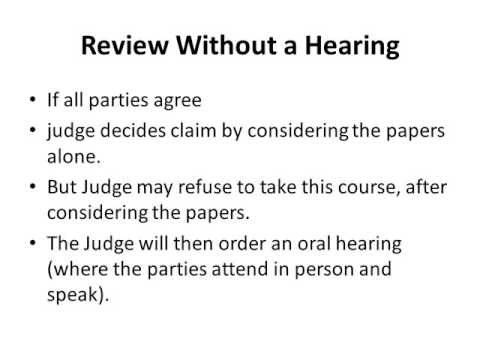
What Does For Review Mean In Court A summons can be used when a criminal indictment is filed, naming a person as a defendant. A party who fails to appear in court in response to a summons after a criminal indictment faces possible arrest. Verdict—The final decision of a petit jury after hearing all the evidence, legal arguments, and instructions from the judge in a civil or criminal trial. A civil verdict might determine whether one party owes money to another party. A criminal verdict would be either guilty or not guilty as to an alleged crime.

During post-disposition, a variety of procedures or hearings regarding the client can require the assistance of counsel. It proceeds through the examination of evidence in a courtroom before a judge or a jury to determine whether a defendant is guilty of the charges in the Information beyond a reasonable doubt. The Omnibus Hearing must be commenced not later than 28 days after the defendant's initial appearance in court under Rule 8 unless the time is extended for good cause related to the particular case. See Minnesota Statutes, section 611A.033, regarding the prosecutor's duties under the Victim's Rights Act to make reasonable efforts to provide advance notice of any change in the schedule of court proceedings. This would include the Omnibus Hearing as well as trial or any other hearing. When the person charged with support lives in another country, state or county, a Uniform Support of Dependents Law petition is filed.

You will have been given acitation, or acomplaint and summons. The citation or complaint includes a short statement of the offense with which you are charged, and states that the offense is a misdemeanor. The citation or summons states a date and time to appear at the county courthouse for yourinitial appearance.If you are under 18years of age, you must have a parent or guardian with you at all court proceedings.

You are strongly urged to get advice from a lawyer or paralegal about appealing a provincial offences court decision. An appeal is not simply a rehearing of the evidence or submissions made at trial. A lawyer or paralegal will be able to advise you about the appeal process, possible appeal outcomes, and questions of law or procedure that may be relevant to your case. In camera reviewmeans a hearing or review in a courtroom, hearing room, or chambers to which the general public is not admitted. A defendant's sentencing hearing represents the final step in a criminal prosecution.

It differs from the trial itself, in that the judge is the only one who decides the official sentence. He or she does have a bit of assistance in the form of a pre-sentencing letter to the judge, which is prepared by a probation officer after an investigation. The burden of proof, while still on the prosecution, is much lower during a preliminary hearing than it is during the trial. At trial, the prosecution has the burden of proving each element of the charged offense beyond a reasonable doubt.

But at the preliminary hearing, the prosecution need only show probable cause exists—in other words, enough evidence to justify a belief that a crime occurred and the defendant committed it. A person other than a judge authorized by Colorado law or by Colorado court rules to make orders or judgments in court proceedings, like trials or hearings. Classification form—A document that tells the Clerk of Court something about the legal nature of a civil case. The classification form will indicate if it is an injury claim, a protection order case, a business case, etc. This form is required so the Clerk's Office and eventually the judge can handle it properly.

By local rule, a party filing a civil case must fill out a classification form when the complaint is filed. The Clerk's office has blank forms for people filing cases. Refers to any program that is an alternative to the filing of a court petition and which keeps the youth from entering the juvenile court system by referring the child to counseling or other social services. Diversion is designed to enable youth to avoid a formal charge through the filing of a petition, which could result in adverse collateral consequences and, ultimately, a juvenile delinquency record. By completing the requirements of a diversion program run by the police department, court, prosecution's office, or an outside agency, the youth can avoid prosecution. The juvenile equivalent of an adult sentence, disposition is a final decision as to how a juvenile's case is handled after an adjudication.
Disposition outcomes vary and may include but are not limited to, fines, restitution, community service, in-home placement under supervision or probation, and out-of home placement in commitment facilities. See also Disposition Hearing; Dispositional Order; Disposition Plan. Typically there are two formal opportunities for the prosecution and defense to negotiate a disposition on a case. The first occurs before the preliminary hearing; the second occurs after the preliminary hearing and before trial. In both instances a judge will sit "in conference" with the DDA and the defense attorney and must approve any negotiated settlement. Many cases are resolved in plea bargains at either stage of the proceedings.


